Almost-Monthly Blogs ⟡ Join the Newsletter ⟡ Continuously Updating Japanese Lessons

One of the first, most important things to do when you start learning Japanese is to learn the writing system. Though it can feel daunting, learning to write in Japanese can also be fun and rewarding.
Once you learn how to write hiragana, you’ll also learn how to recognize and read it! Hiragana is the first script little kids in Japan learn, so let’s learn it first, too.
Download the free hiragana worksheet PDFs below, and let’s get started.
The Japanese Writing System
The Japanese language utilizes three scripts: Hiragana, Katakana, and Kanji. By combining all three, we can read Japanese, but first things first, what are all of these scripts?
Unlike the alphabet, hiragana and katakana are considered “syllabaries” since each character comprises a consonant + vowel sound. This is except for “ん”, which makes an “n” sound.
Hiragana and katakana express the same phonemes (sounds), but use different characters. Both syllabaries contain 46 characters each.
Hiragana was also initially invented by women of the imperial court, whereas katakana was created by monks as a shorthand for Chinese characters.
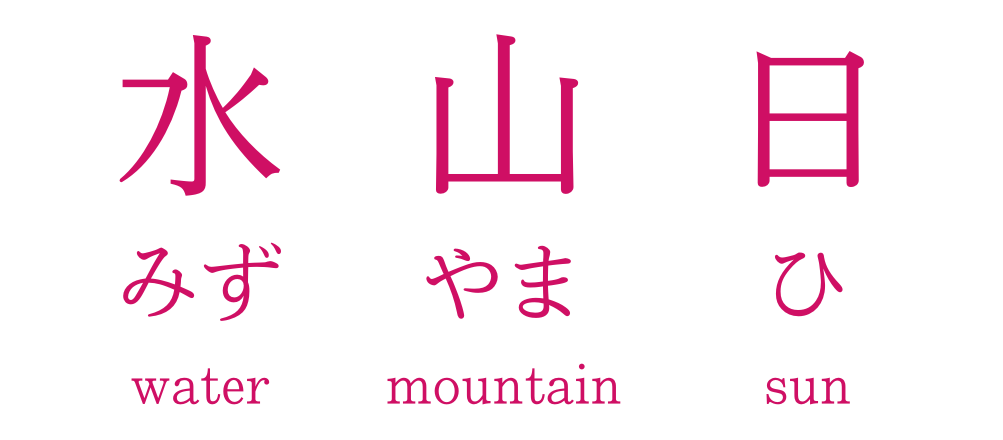
Kanji, on the other hand, is derived from Chinese characters imported to Japan circa the Shang Dynasty. These characters served as the origin for modern hiragana and katakana. Today, there are about 2000 kanji necessary for everyday use. I know it’s a lot, but don’t worry, we’ll get there in time.
Rōmaji is also used, but since it’s essentially the alphabet, we don’t need to learn it from scratch. In this lesson, we’ll focus on learning how to write Hiragana. You’ll also learn how to recognize the characters through practice and repetition using my practice worksheets.
What is Hiragana Used For?
Hiragana is the most basic writing system in Japanese. It can be used to write any word in Japanese, but in the “real world”, it only makes up a percentage of written characters in a given passage:
“My name is Kat.”
All hiragana writing vs.
わたしのなまえはきゃっとです。
(watashi no namae *wa kyatto desu.)
Natural writing in Japanese (using all 3 scripts).
私の名前はキャットです。
(watashi no namae *wa kyatto desu.)
So, hiragana is mainly used for words that don’t have or need kanji, or as “okurigana”. Okurigana are just the hiragana characters at the end of kanji words.
For example: “to eat” 食べる (taberu). We’ll learn more about kanji in Lesson 5, so don’t worry about this yet.
*In specific cases, hiragana representing “particles” will sound differently. We’ll touch on this in a future lesson on grammar.
Learn to Recognize and Write Hiragana
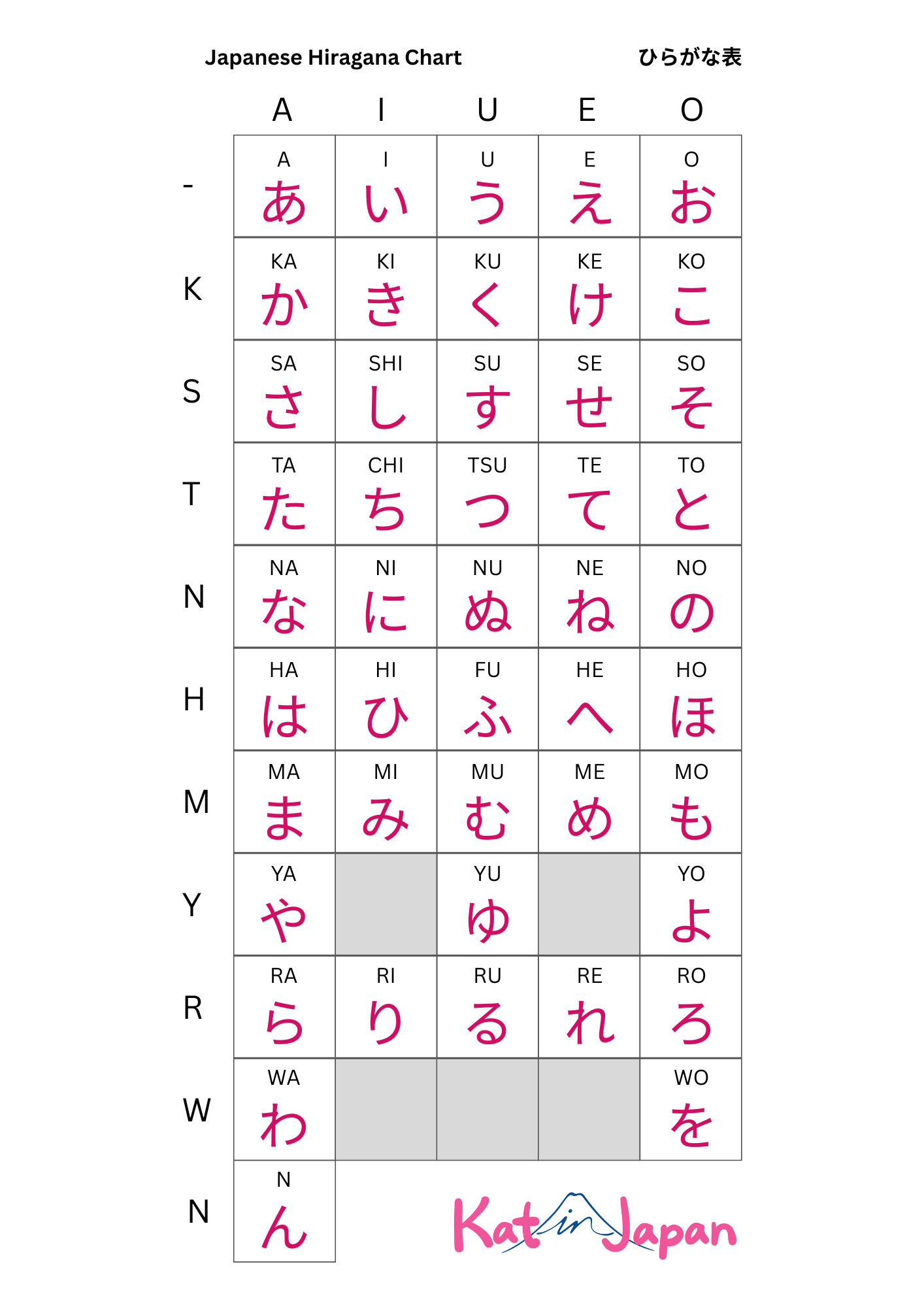
This chart covers all 46 basic hiragana characters. Similar to how the English alphabet has its own order (a, b, c, d, etc.), the hiragana syllabary is ordered “a, ka, sa, ta, na, ha, ma, ya, ra, wa, n”.
You’ll notice that almost every row has 5 syllables, except for ya, wa, and n. Modern Japanese doesn’t use these missing syllables, so don’t worry about them.
Pronunciation Note:
The vowel sounds in Japanese differ from English. Whereas in English, we can pronounce the letter “A” as “ah” or “ay”, etc, Japanese has stricter pronunciation rules. Each vowel has a relatively concrete pronunciation:
- あ “ah” as in “father” (IPA: a)
- い “ee” as in “free” (IPA: i, i̥ )
- う “oo” as in “loop” (IPA: ɯ, ɯ̥ )
- え “eh” as in “bet” (IPA: e)
- お “oh” as in “only” (IPA: o)
(International Phonetic Alphabet “IPA” symbol is included for clarity)
In lesson 3, we’ll learn how to add “voiced” sounds to some of the syllables in writing. We’ll also learn how to combine the syllables to create some basic words.
For now, focus on tracing the shape of each hiragana with the provided worksheets and stroke order video.
Get the Free How to Write Hiragana Practice Worksheets
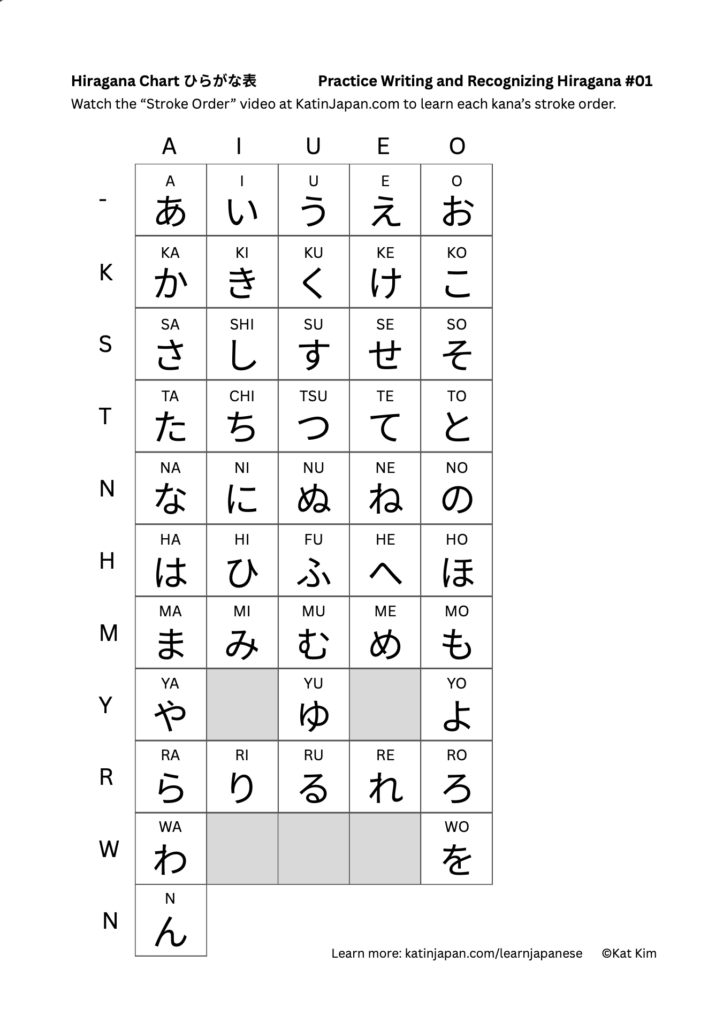
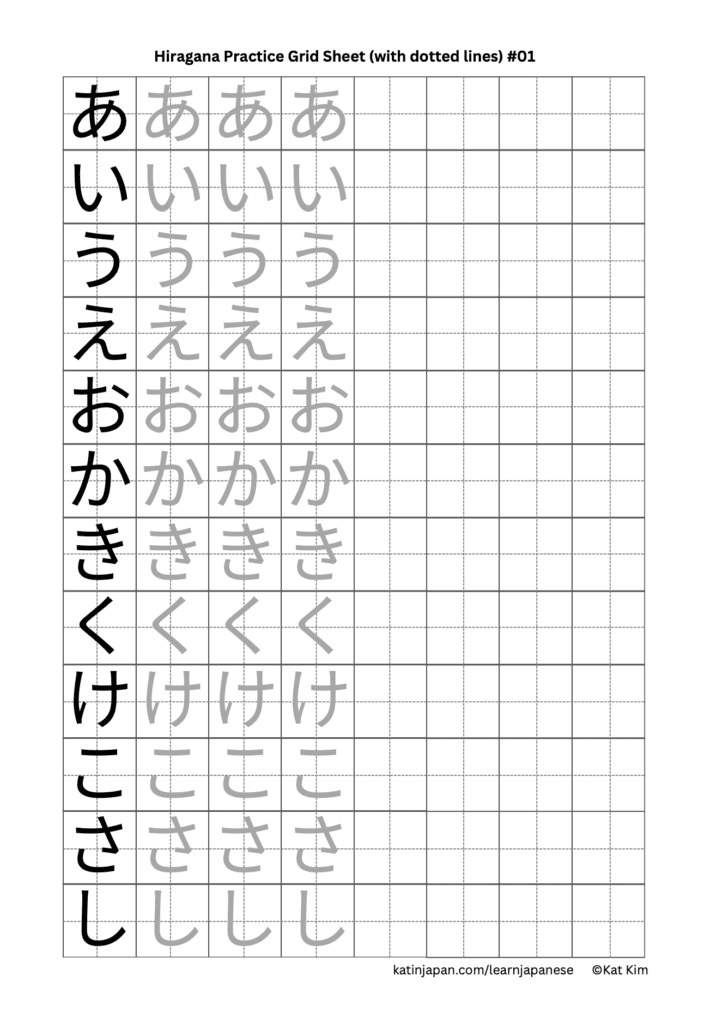
Download the PDFs Here. These download as a .zip file, so unzip the file to access the PDFs.
If that doesn’t work, try downloading it from my Ko-Fi page. Consider supporting me if you enjoy these lessons:
Follow Along to the Hiragana Stroke Order Video
Happy learning!
Disclaimer: Since I write my blog as a hobby and have a full-time job, the next 3 lessons about the Japanese writing systems will be coming out over the next 1-2 months. I’ll try to be expedient about writing and uploading. If you’re trying to learn by yourself, I recommend the Genki series by The Japan Times or the Minna no Nihongo series to fill in the gaps.