Almost-Monthly Blogs ⟡ Join the Newsletter ⟡ Continuously Updating Japanese Lessons

Welcome to the second lesson in my Learn Japanese series. In this section, let’s learn how to recognize and write Katakana with the correct stroke order. If you haven’t learned about Hiragana yet, go back one lesson.
Download the free katakana worksheet PDFs below and let’s get started.
What is Katakana?
Katakana is the second syllabary used in Japanese. Buddhist monks originated it as a shorthand for kanji, aka Chinese characters. They wanted a quicker way to write the complex characters, and so katakana was developed.
Now, Katakana is used to express foreign loanwords in Japanese, to emphasize specific words and onomatopoeia, and even as flair on advertisements and packaging. Katakana uses sharper, more concise strokes, but some characters look the same as their hiragana counterparts.
Katakana also expresses the exact same sounds (phonemes) as hiragana. So あ sounds the same as ア.
Pronunciation Note:
Each vowel has a relatively concrete pronunciation. By combining a consonant and vowel sound, we can produce the sounds of the Japanese language.
- ア “ah” as in “father” (IPA: a)
- イ “ee” as in “free” (IPA: i, i̥ )
- ウ “oo” as in “loop” (IPA: ɯ, ɯ̥ )
- エ “eh” as in “bet” (IPA: e)
- オ “oh” as in “only” (IPA: o)
(International Phonetic Alphabet “IPA” symbol is included for clarity)
- カ “ka”
- サ “sa”
- タ “ta”
- ナ “na”
- ハ “ha”
- マ “ma”
- ヤ “ya”
- ラ “ra”
- ワ “wa”
- ン “n” as in “wagon“(IPA: N)
Because katakana is used to write foreign loanwords, it often utilizes “small letters” (拗音 Yōon) to help guide pronunciation.
For example, パーティー (party) uses a small ‘イ,’ so it sounds more like the English “party”. You’ll learn more about using small characters and digraphs (two-character sounds) in the next lesson.
Learn the stroke order for katakana by following along with the video below.
Learn to Recognize and Write Katakana
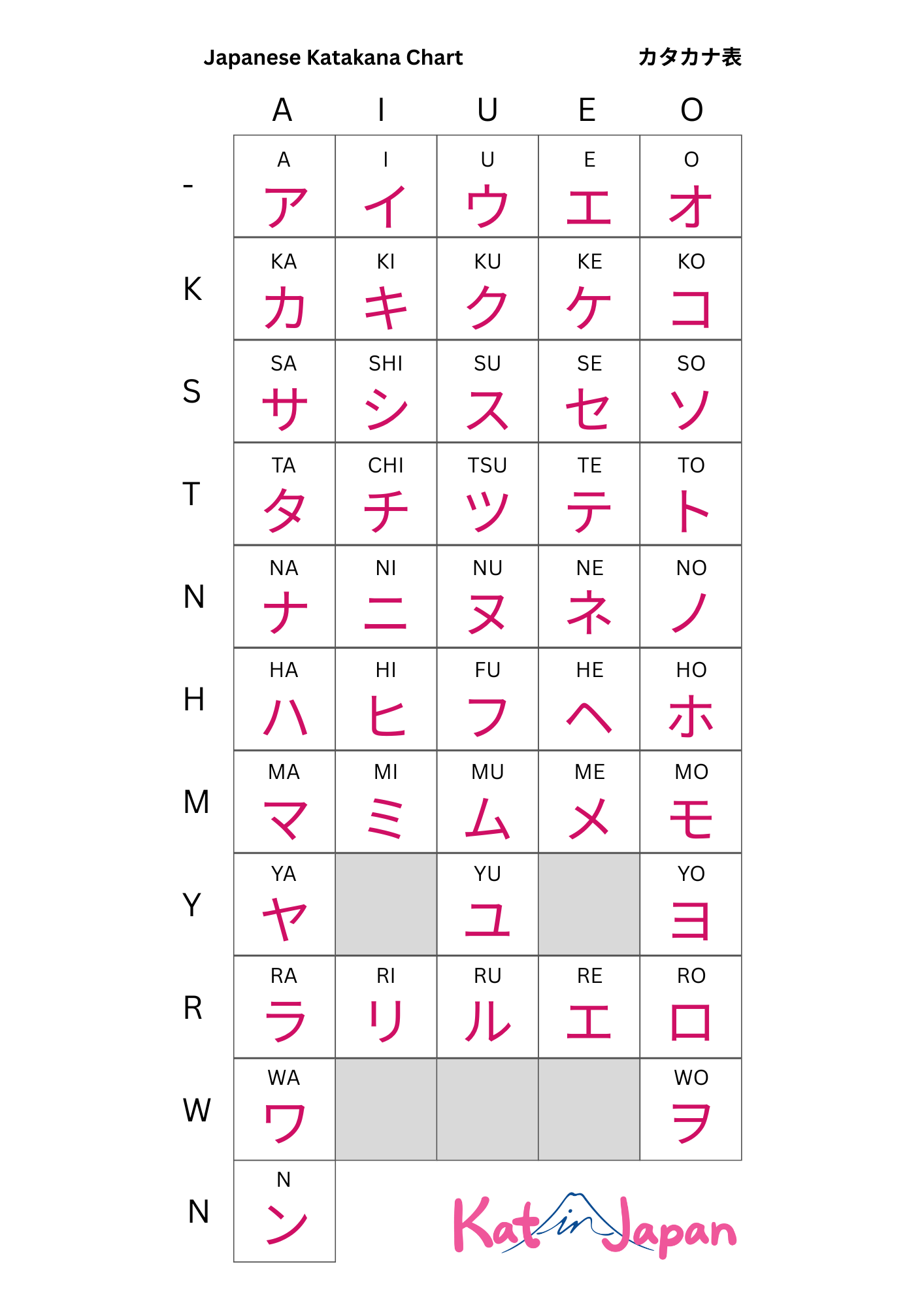
This chart covers all 46 basic katakana characters. Similar to how the English alphabet has its own order (a, b, c, d, etc.), the katakana syllabary is ordered “a, ka, sa, ta, na, ha, ma, ya, ra, wa, n”.
We’ll talk about combining characters in depth in the next lesson.
Get the Free How to Write Katakana Practice Worksheets
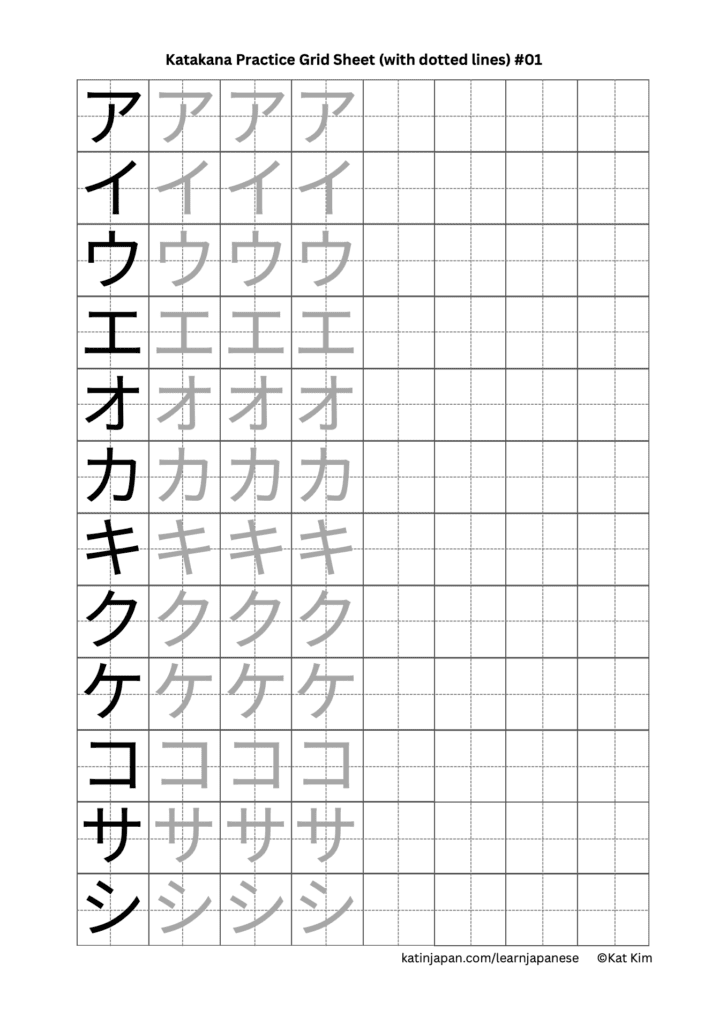
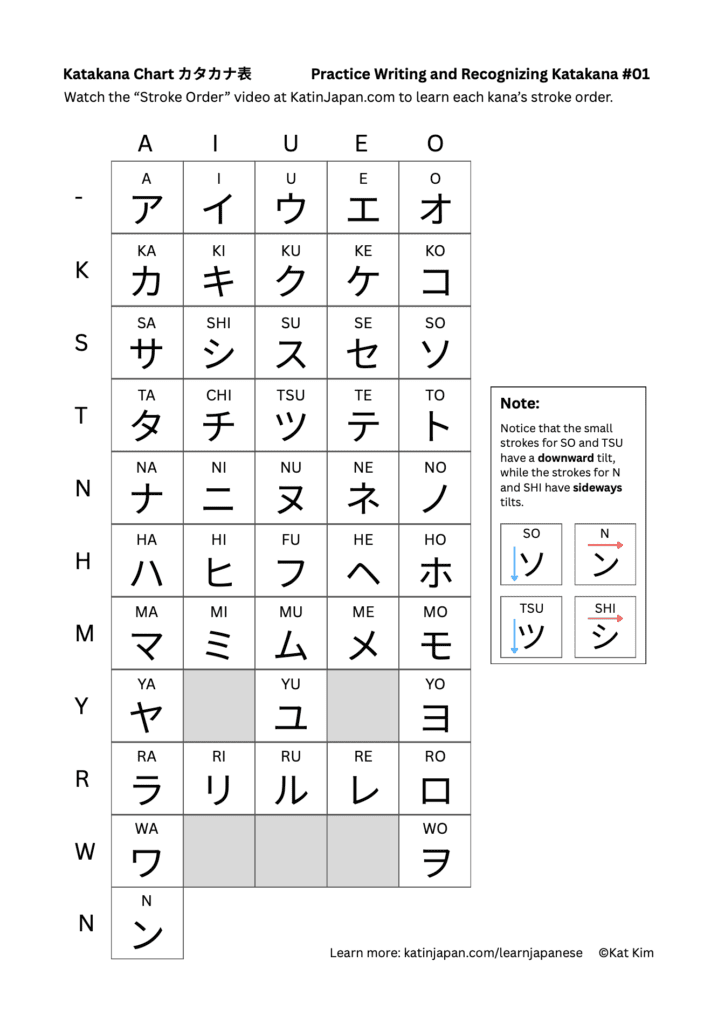
Download the PDFs Here. These download as a .zip file, so unzip the file to access the PDFs.
If that doesn’t work, try downloading it from my Ko-Fi page. Consider supporting me if you enjoy these lessons:
Follow Along to the Katakana Stroke Order Video
Punctuation Note:
When writing in Katakana, we can use a special dash to indicate the elongation of a vowel sound. For example “o” vs. “ohh”.
ー 長音符 (chō’onpu)
It looks like the kanji for “one”, but it’s actually its own character, so be careful! And it essentially acts as a letter, so be sure to include it in words like チョコレート (chokorēto)、ウール (ūru)、チーム (chīmu)、etc.
More Practice
Here are some katakana words you can practice writing after you finish practicing each individual character. As a fun bonus, try writing your name in katakana, too!
As you write, notice how the sounds in Japanese correlate to the English loanword. Sometimes they aren’t intuitive, but just keep practicing, and you’ll get them in no time.
アップル apple
インク ink
イタリアン italian
ウール wool
ウード wood
ウオーター water
エレファント elephant
オレンジ orange
カード card
キウイ kiwi
キロ kilo
クレジット credit
ケルビン (degrees) kelvin
コーヒー coffee
サラダ salad
サービス service (free)
シーウィード seaweed
シークワサー shikuwasa (citrus depressa)
スルー through
スモール small
セロリ celery
ソフトボール softball
タッチ touch
チュロス churros
チームメイト teammate(s)
ツーブロック two block (hairstyle)
テンプル temple
トータル total
トラブル trouble
ナビ navigation
ニュース news
ヌードル noodle(s)
ネクタイ necktie
ノーベル Nobel
ハウス house
ハッピー happy
ヒーロー hero
フレッシュ fresh
ヘルプ help
ホリディ holiday
マザー mother
ミートソース meat sauce
ムード mood
メディウム medium
モデル model
ヤード yard
ユニーク unique
ヨーロパ europe
ヨグルト yogurt
ライト light ラーメン ramen
リラックス relax
ルール rule
レール rail
レジュメ resume
レポート report
ローン loan
ロード road
ワンタイムパスワード one time password
ヲチ watch