Almost-Monthly Blogs ⟡ Join the Newsletter ⟡ Free PDFs

Now that you’ve learned about hiragana, katakana, how to write voiced sounds and digraphs, and romaji, let’s move on to kanji.
Although there are too many kanji to list here, you can use this guide to learn the basics of kanji. By using this guide, you can start learning kanji, and build good habits for continuous learning.
As a beginner, you don’t need to know tons of kanji. But let’s do an overview of they are and how to use them.
What are Kanji?
Chinese characters themselves were derived from oracle bone drawings over 3000 years ago. Each pictogram had a specific meaning, like “sun” or “dance”. In the years following, these pictograms became proper characters. Then they arrived in Japan around 700CE from Tang dynasty China.
Buddhist monks and nobility took the Chinese characters and their associated meanings to represent the sounds of spoken Japanese. Eventually they also developed man’yogana from kanji and later used it to create katakana and hiragana.
However kanji remains in use even today, much to the consternation of non-Chinese/Japanese speakers. While not every word is written in kanji, it is heavily utilized in daily life, making them absolutely necessary for learning Japanese.
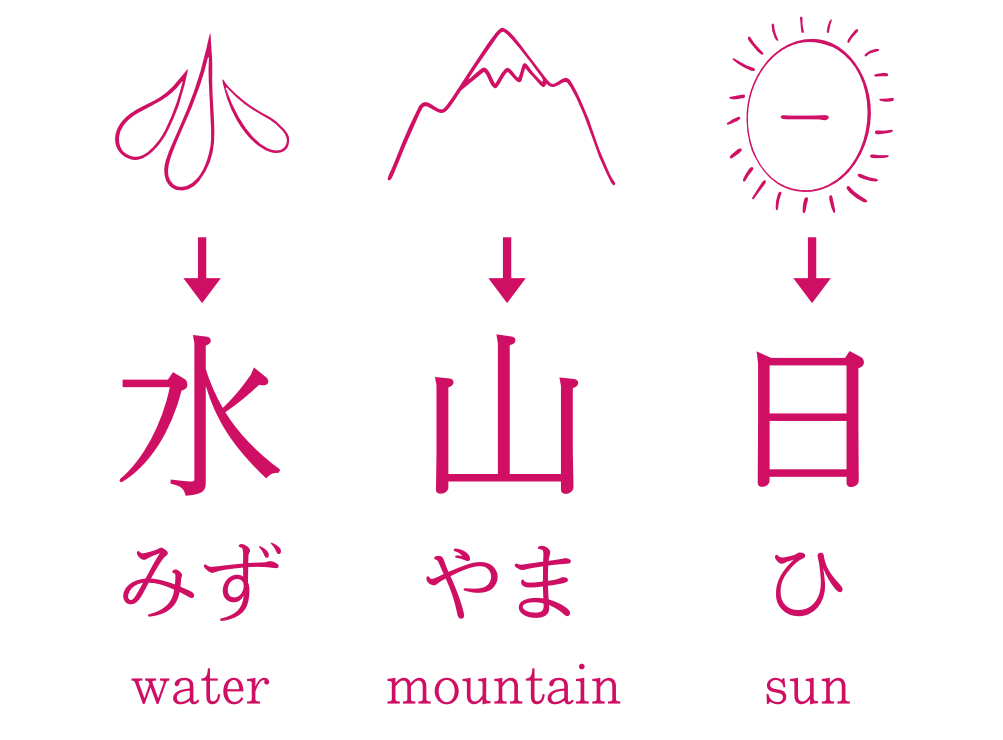
In Japan, there are over 2000 everyday-use kanji, called “Joyo Kanji”. But the key to learning them is not to get overwhelmed by their sheer number, but to keep an open mind as you learn them.
Modern kanji often have a few related meanings. For example “日” means “sun” but also “day”, increasing their complexity. But despite this, learning kanji can be very rewarding and even fun… if you’re unhinged like me.
Since kanji are very different from the English alphabet, it takes time to grow accustomed to how to write them. But just keep practicing, and you’ll get them eventually!
So let’s learn how to write and read kanji, and the best ways to practice.
Using Correct Stroke Order
When you learn to write kanji, there is a certain stroke order you should follow. By learning the correct stroke order from the getgo, you can learn kanji faster and more accurately as you become an advanced Japanese learner.
Generally, the stroke order for kanji is from left to right, then top to bottom. This is because Chinese and Japanese were traditionally written and read from top to bottom, left to right (and still are).
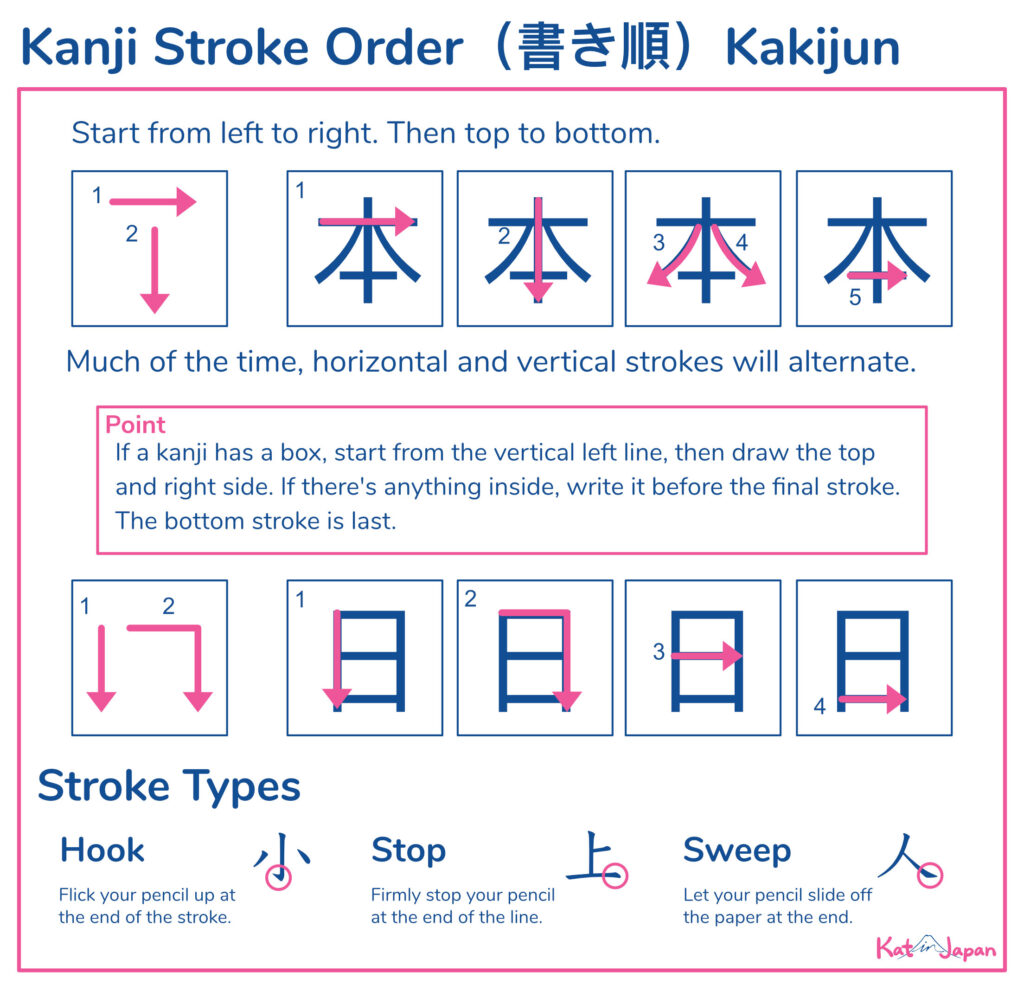
When you learn kanji, write them using the prescribed stroke order. Even though it’s sometimes unintuitive when coming from an English background, the stroke order matters more and more as you become familiar with Japanese.
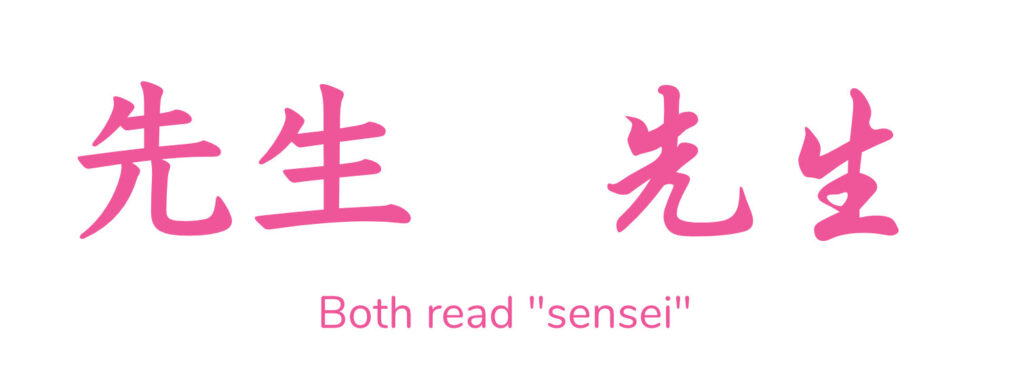
For example, think of cursive. If you don’t understand how English letters are written, you can’t parse cursive writing. The same is true in Japanese. If you don’t know the correct stroke order, reading handwritten kanji later on will become impossible.
Also, kanji have three stroke types: hook (はね), stop (とめ), and sweep (はらい). When you’re practicing kanji, try to focus on these different shapes as you write.
Tips for Writing
When you practice writing, try using a mnemonic system. These are little tricks that help you memorize the meaning of kanji. For example, “山” (yama) looks like a mountain with three peaks.
Mnemonics will help to cement the meanings in your brain. I highly recommend the Kanji Look and Learn Series by The Japan Times, the same publisher as Genki, for this. (Not sponsored, but hit me up!)
Also, if you don’t know the meaning or reading of a kanji, one of my favorite online resources in Jisho.org, which has a lot of great features as a Japanese English dictionary. And it’s amazing for diving deeper into kanji.
By the way, you don’t have to be perfect when you write kanji. Imagine each character in its own square to help develop your sense of writing balance. Then try your best to mimic the shapes you see in each kanji character. They might look scrapped together at first, but you’ll improve over time.
What are Kanji Radicals?
Each kanji character is made up of at least one radical. Even the most basic kanji can become key “radicals” aka 部首 (bushu). Radicals are just smaller kanji that help make up different parts of more complicated kanji.
For example, the kanji for “moon” (月) can be seen as a part of “a time period” (期); 月→期. . Each radical starts out as its own kanji, and therefore has its own stroke order, even when part of a larger kanji. Knowing basic characters will therefore compound your knowledge in general.
Radicals also have their own names and quirks, but don’t worry about them now. Just know that radicals can take many different places in a kanji, like so:
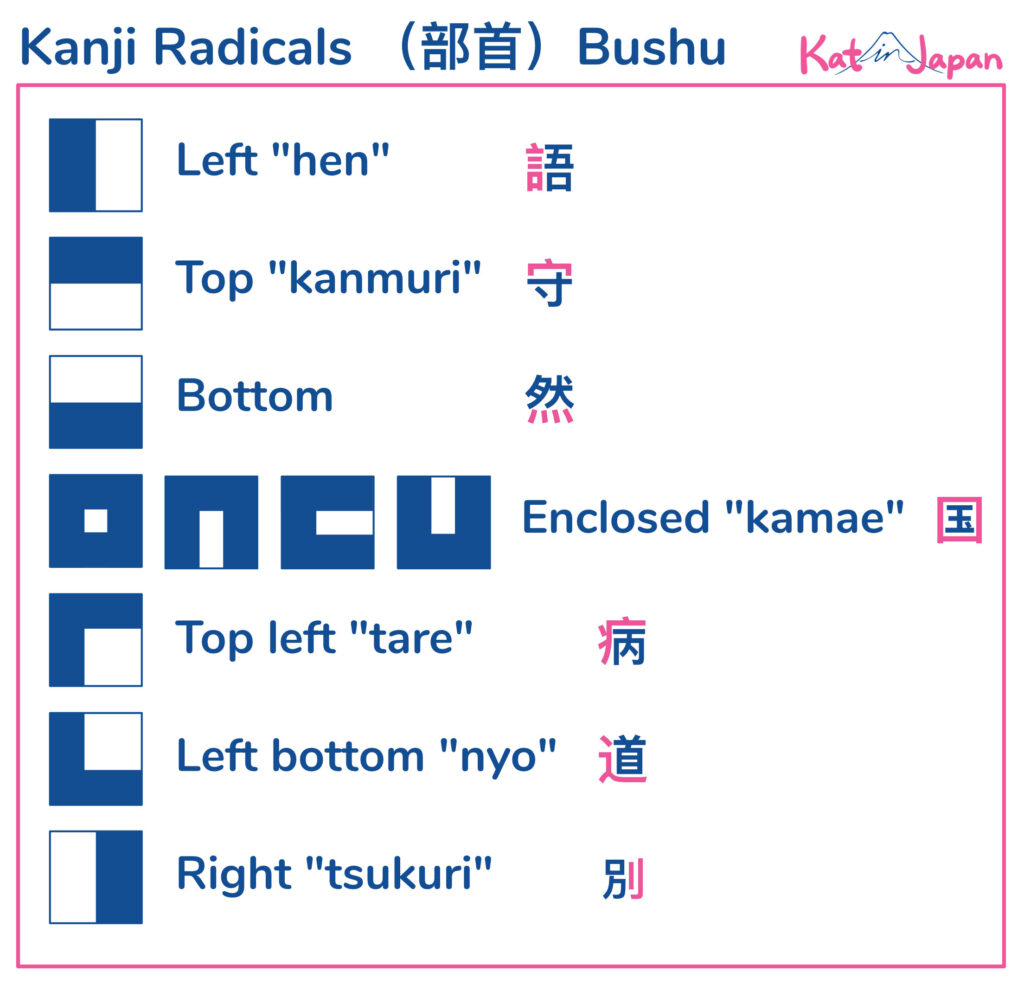
In the beginning, start by familiarizing yourself with basic kanji. You will naturally notice some patterns. Once you reach an intermediate kanji level, around 500 kanji, you can start paying more careful attention to them.
Practice Writing Basic Kanji
Download the FREE PDFs Here. These download as a .zip file, so unzip the file to access the PDFs.
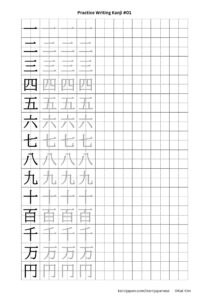
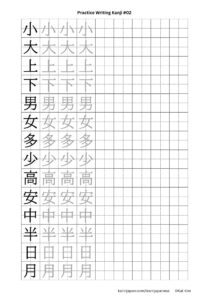
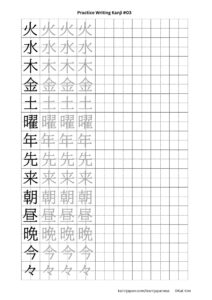
If that doesn’t work, try downloading it from my Ko-Fi page. Consider supporting me if you enjoy these lessons:
Practice Writing Set 1
Let’s practice writing some basic kanji characters for numbers. If you need more boxes to practice, you can download these blank practice worksheets, too. Or feel free to practice along in your own notebook or tablet.
一(いち)(ichi) one
二(に)(ni) two
三(さん)(san) three
四(*よん・し)(yon/shi) four
五(ご)(go) five
六(ろく)(roku) six
七(なな・しち)(nana/shichi) seven
八(はち)(hachi) eight
九(きゅう・く)(kyuu/ku) nine
十(じゅう)(juu) ten
百 (ひゃく)(hyaku) one hundred
千 (せん)(sen) one thousand
万(まん)(man) ten thousand
円(えん)(en) yen ¥
*There are more readings for the numbers, which we’ll address in How to Count in Japanese.
**The character 々 doubles the reading of the previous kanji. Ex.) 日々(ひび)”days”, 時々(ときどき)”sometimes”.
Practice Writing Set 2
These are important opposite kanji characters to know. Try to remember these in sets.
小(ショウ)(shou)、小さい(ちいさい)(chiisai) small
大(ダイ) (dai)、大きい (おおきい)(ookii) big
上(うえ、ジョウ)(ue, jou) up
下(した、ゲ)(shita, ge) down
男(おとこ、ダン)(otoko, dan) man
女(おんな、ジョ)(onna, jo) woman
半(ハン)(han) half
多(タ) (ta)、多い(おおい)(ooi) many, much
少(ショウ) (shou)、少ない(すくない)(sukunai) few, little
高(コウ) (kou)、高い(たかい)(takai) high, tall
安(アン) (an)、安い(やすい)(yasui) cheap, low
中(なか、チュウ)(naka, chuu) middle, in
**々 (repeater)
Practice Writing Set 3
Let’s check some handy kanji for days of the week, dates, and times. I’ve written the kun’yomi in hiragana, and the on’yomi in katakana because the on’yomi reading is originally from Chinese.
日(ひ、び、ニチ)(hi, bi, nichi) sun, day
月(つき、ゲツ、ガツ)(tsuki, getsu, gatsu) moon, month
火(ひ、カ)(hi, ka) fire
水(みず、スイ)(mizu, sui) water
木(き、モク)(ki, moku) tree
金(かね、きん)(kane, kin) gold, metal
土(つち、ド)(tsuchi, do) earth
曜 (よう)(you) weekday
年(とし、ネン)(toshi, nen) year
先(さき、セン)(saki, sen) to precede, before
来(*く.る、ライ)(kuru, rai) to come, next
朝(あさ、チョウ)(asa, chou) morning
昼(ひる、チュウ)(hiru, chuu) afternoon
晩(バン)(ban) evening
時(とき、ジ)(toki, ji) time
今(いま、コン)(ima, kon) now
By combining the above characters, we can start to make full words like 月曜日(げつようび)”getsuyoubi”, aka Monday.
*The period after く indicates that there are okurigana following the kanji. In this case: 来る. Let’s learn about okurigana below.
How to Read Kanji
Kanji are infamous for having lots of readings and being very complicated. But for the sake of simplicity and learning, it’s best to start with the most basic readings of kanji.
You can make flashcards with the kanji on one side and 1-2 readings or 1-2 key words on the other. Then drill each kanji once a day to improve your memory.
一 (いち)one
This kanji for “one” can be written as a standalone with the reading “ichi”. But it can also be combined with other characters. This reading is the Chinese reading (on’yomi).
一つ (ひとつ)one (thing)
This reading is the Japanese reading (kun’yomi).
少女 (しょうじょ)girl
This word for “girl” is a combined kanji word. It joins the on’yomi of both characters: 少(しょう)”small” and 女(じょ)”woman”.
How to Connect Kanji with Hiragana
When writing kanji in modern Japanese, you will often combine them with hiragana or other kanji. Let’s check the examples below.
1. 食べる(たべる)to eat
2. 朝食(ちょうしょく)breakfast
3. 食(しょく)meal
- The kanji 食 takes the place of “た”. It has a reading of “ta” in this case. This reading is the Japanese reading (kun’yomi).
- Now 食 is combined with 朝 to create a compound kanji word: 朝食 “choushoku” aka breakfast. By combining two kanji, we can create a new word. This is an example of the Chinese reading (on’yomi).
- Written alone, 食 becomes the word “meal”. It can also be combined with other kanji as above.
As you can see, kanji characters can be combined or left alone. By the way, hiragana that follow the kanji are called “okurigana”. Okuragana literally means “characters following” the kanji.
They also have more than one reading, each. For beginners, you just need to know the main one or two readings. As you progress, you will inevitably learn more.
Furigana and Ruby
Sometimes you will see helpful text written above a kanji word. This pronunciation guide is called “furigana”. It means these hiragana have been “thrown” above the kanji.
Due to limitations for adding these furigana above the text you will sometimes see furigana in parentheses following the kanji. Sometimes furigana is also referred to as (ルビ) ruby text.
わたし えいが み
私は映画を見ます。
私(わたし)は映画(えいが)を見(み)ます。
In the future, we’ll go more in-depth on kanji radicals, how to remember kanji effectively, and points for continued learning.
References: Kanji Look & Learn by Eri Banno