Almost-Monthly Blogs ⟡ Join the Newsletter ⟡ Continuously Updating Japanese Lessons

So, you’ve learned how to write and recognize the 46 characters of both hiragana and katakana. That’s impressive, but we’re not done yet.
You might have wondered about sounds like g, b, j, z, or p. And what about sounds that come up in memes and anime like ‘nya’?
In this lesson, we’ll cover three big points when writing in Japanese: voiced sounds, digraphs and small letters, and how to use the small “tsu”.
Writing Voiced Sounds (Using Maru and Ten-ten)
Whereas we have separate letters like “t” and “d” in English, Japanese uses special marks to designate new sounds using the existing syllabaries. By adding the marks to the side of a hiragana or katakana symbol, we can change the sound it makes.
These special marks are called diacritics, and there are two in Japanese: “maru” and “ten-ten”; basically, a circle and a mark similar to a quotation mark.
By adding these marks to hiragana or katakana, we can show that the sound has changed. For example, from ka → ga (か→が) or ha → pa (は→ぱ).
When we want to write the sounds g, j, z, d, and b in Japanese, we use a *ten-ten. It looks like a quotation mark: ゛
ka ki ku ke ko → ga gi gu ge go
かきくけこ → がぎぐげご
sa shi su se so → za ji zu ze zo
さしすせそ → ざじずぜぞ
ta chi tsu te to → da ji zu de do
たちつてと → だぢづでど
ha hi fu he ho → ba bi bu be bo
はひふへほ → ばびぶべぼ
Similarly, for the p sound, we can use a maru: ゜
ha hi fu he ho → pa pi pu pe po
はひふへほ → ぱぴぷぺぽ
By adding these marks to the symbols, we can make a much larger range of sounds, for example: ぼうし (boushi) hat、ごうかく (goukaku) pass、とんじる (tonjiru) pork miso soup、パラダイス (paradaisu) paradise、です (desu) to be, and so on.
You’ll also notice that not every symbol gets a diacritic mark. That’s because only the K, S, T, and H lines get voiced sounds.
*The official names for these marks are “dakuten” (ten-ten) and “handakuten” (maru), literally “muddy sound” and “semi-muddy sound”.
Punctuation Note:
In addition to the existence of the maru and ten-ten, punctuation marks in Japanese differ from English.
English
Period: .
Comma: ,
Quotation marks: “”
Exclamation mark: !
Question mark: ?
Japanese
。 句点 (kuten)
、 読点 (touten)
「」 Corner Brackets aka カギカッコ (kagikakko)
! 感嘆符 (kantanfu) or びっくりマーク (bikkurimāku)
? 疑問符 (gimonfu) or はてなマーク (hatenamāku)
An example of how to use punctuation marks in Japanese:
わたしのなまえはキャット、アメリカしゅっしんだよ。おこのみやきがすき!えいごで「okonomiyaki」というんだ。あなたはどう?
My name is Kat, I’m from America. I like okonomiyaki. In English, it’s called “okonomiyaki“. How about you?
*Typically !and? are used in casual contexts in Japanese, so I’ve written in a casual style. In Japanese, the particle “か” is used to asked questions. More on this in a future lesson.
Practice Writing Voiced Sounds
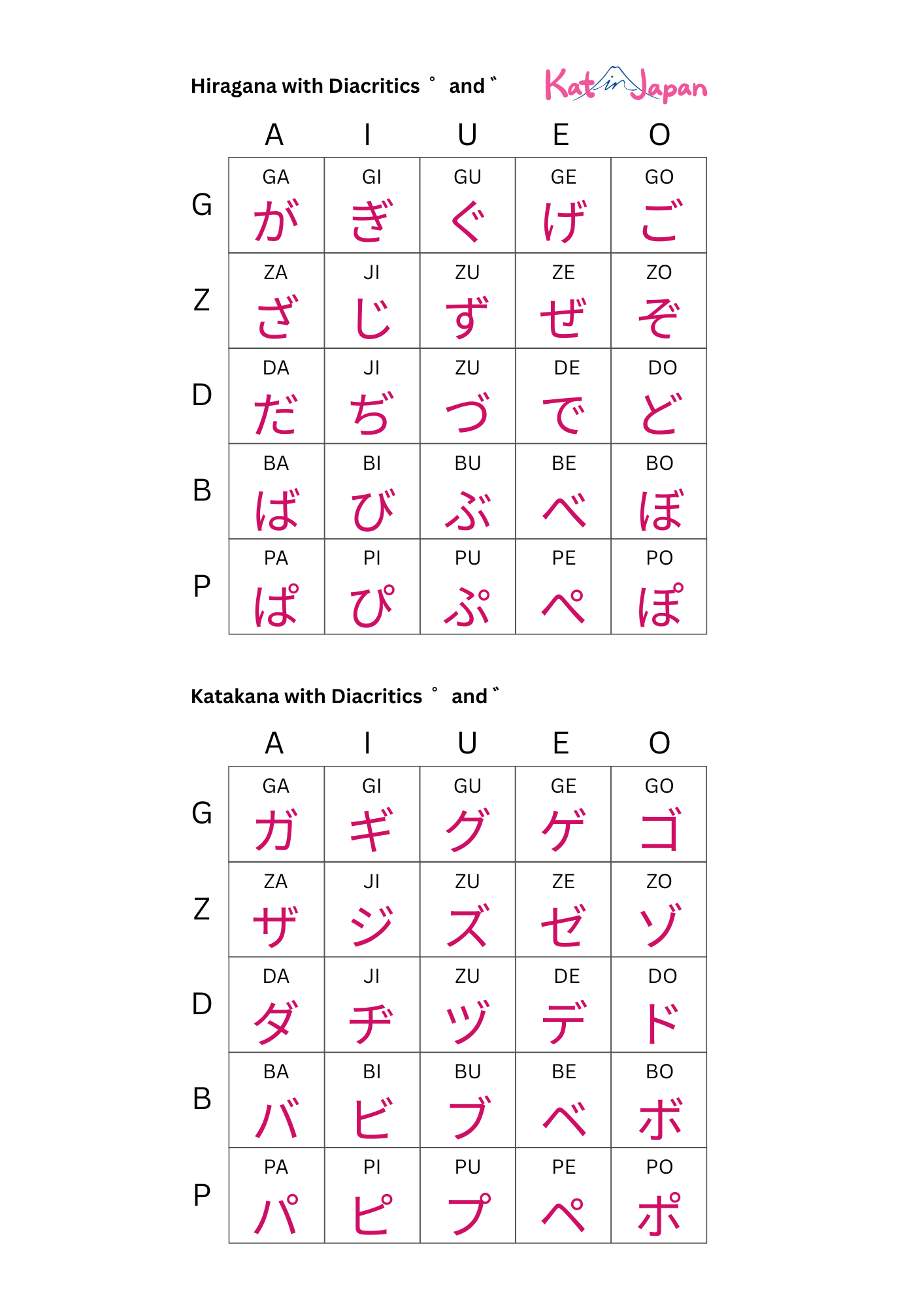
Now that you know what those little marks are for, let’s practice writing them.
Download the FREE Practice Worksheets
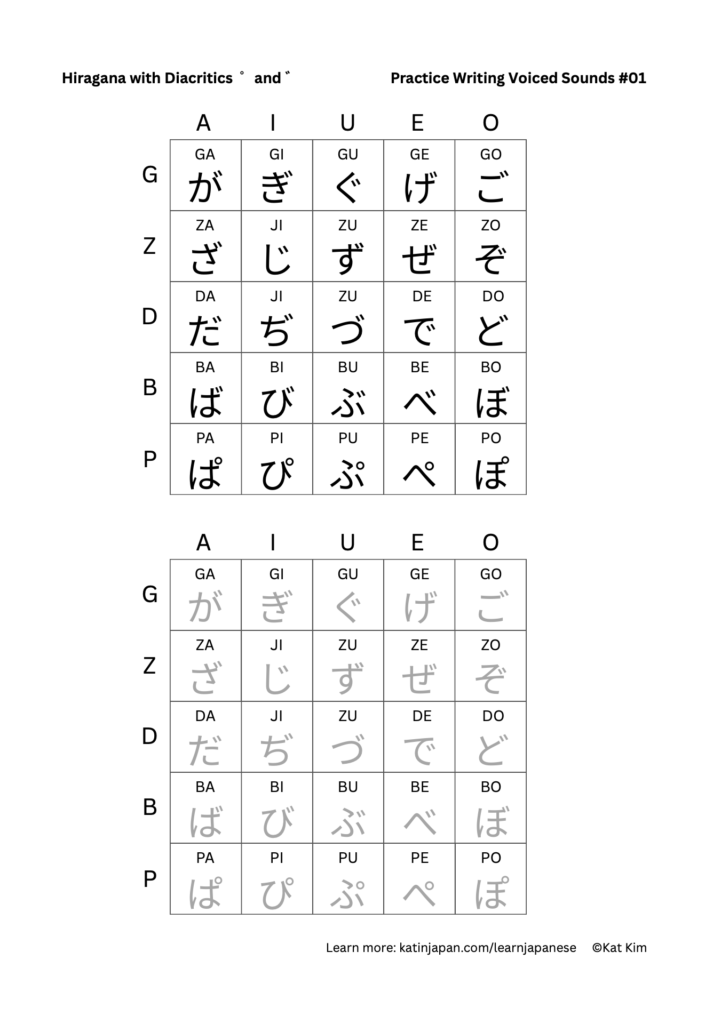
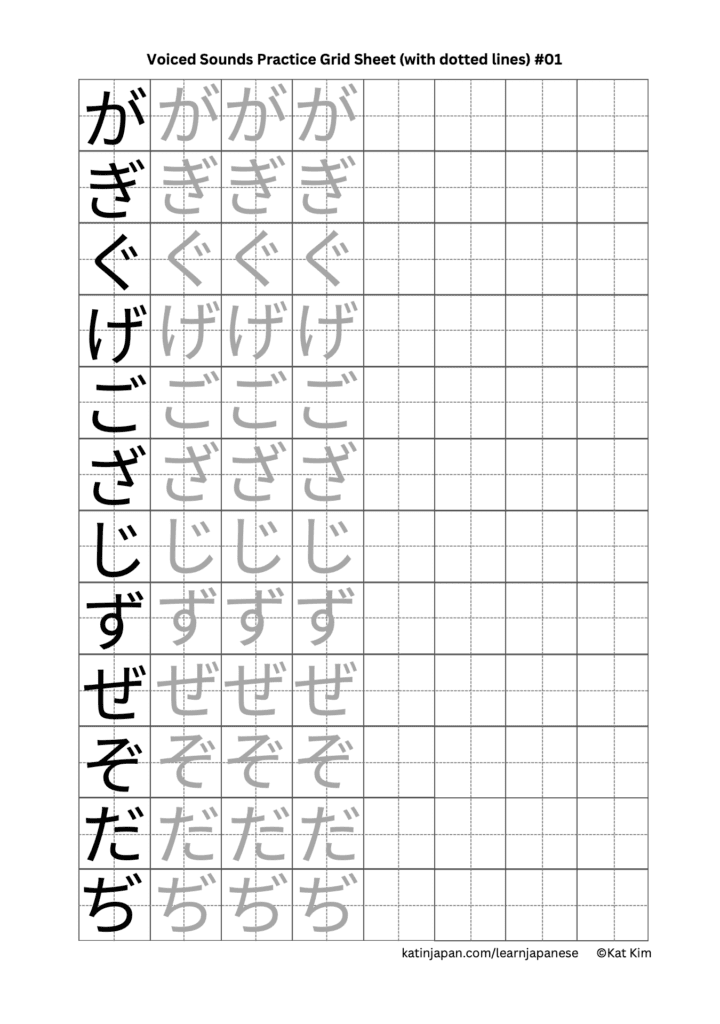
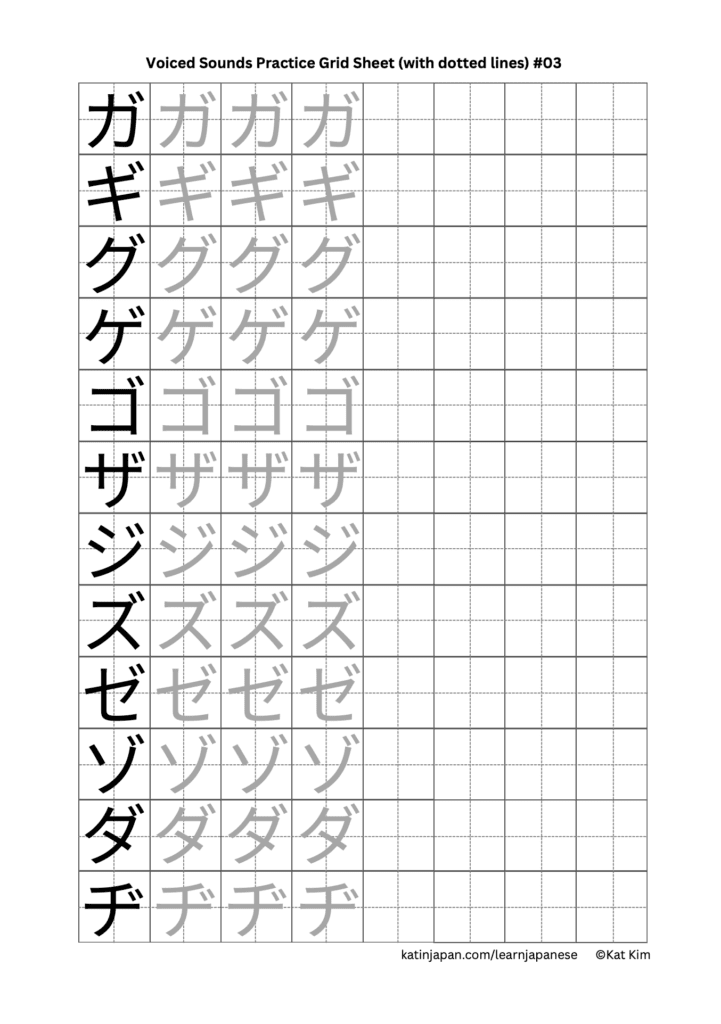
Download the practice sheets here to get started. Or download them from my Ko-fi. And if you find them useful, consider supporting me with a tip!
Writing Digraphs Like “Nya”
To make sounds like “kya”, “nya”, and more, we need to combine the symbols we already have with another character. Allow me to introduce “small” letters.
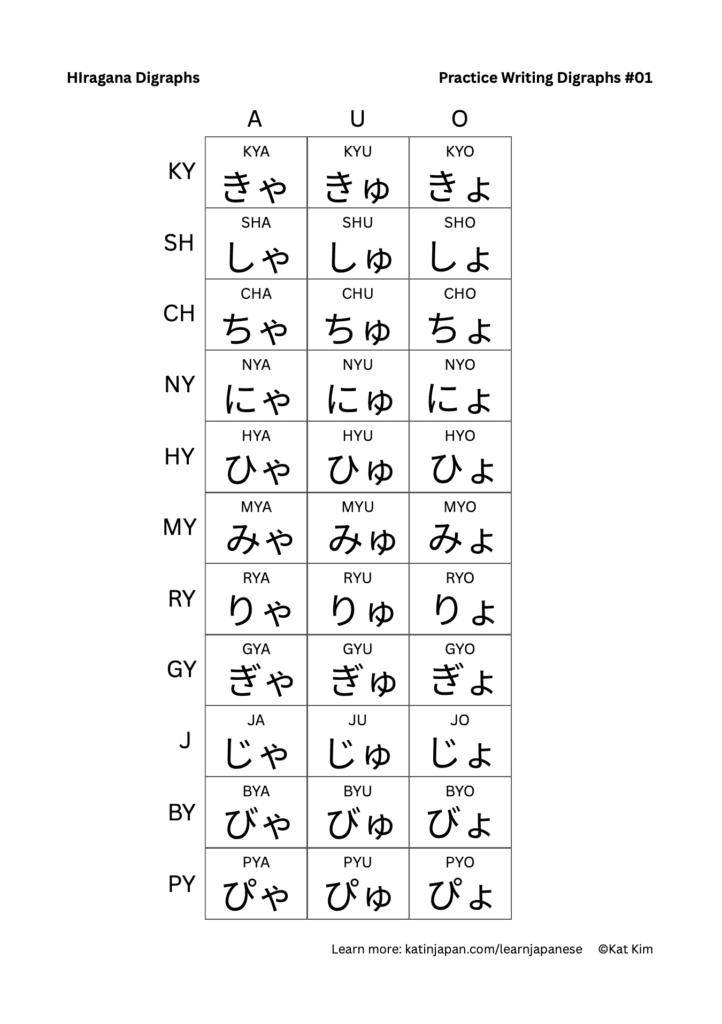
By combining the “I” column of hiragana or katakana with the small letters, ゃ ゅ or ょ, we can make another set of sounds.
For example:
RI + small YA = RYA
り+ゃ=りゃ
RI + small YU = RYU
り+ゅ=りゅ
RI + small YO = RYO
り+ょ=りょ
These are called “digraphs” because they combine two letters to create one sound. In English, we have digraphs like “sh”, “th”, and “ch”.
We can also combine them with the voiced sounds from before to create sounds like “ja”, “bya”, “gyo”, and more. Practice recognizing the digraphs in both hiragana and katakana below.
In Japanese, these digraphs are called 拗音 (yōon) or “twisted sounds” because it sounds like you’re twisting the “i” sound around.
Practice Recognizing Japanese Digraphs
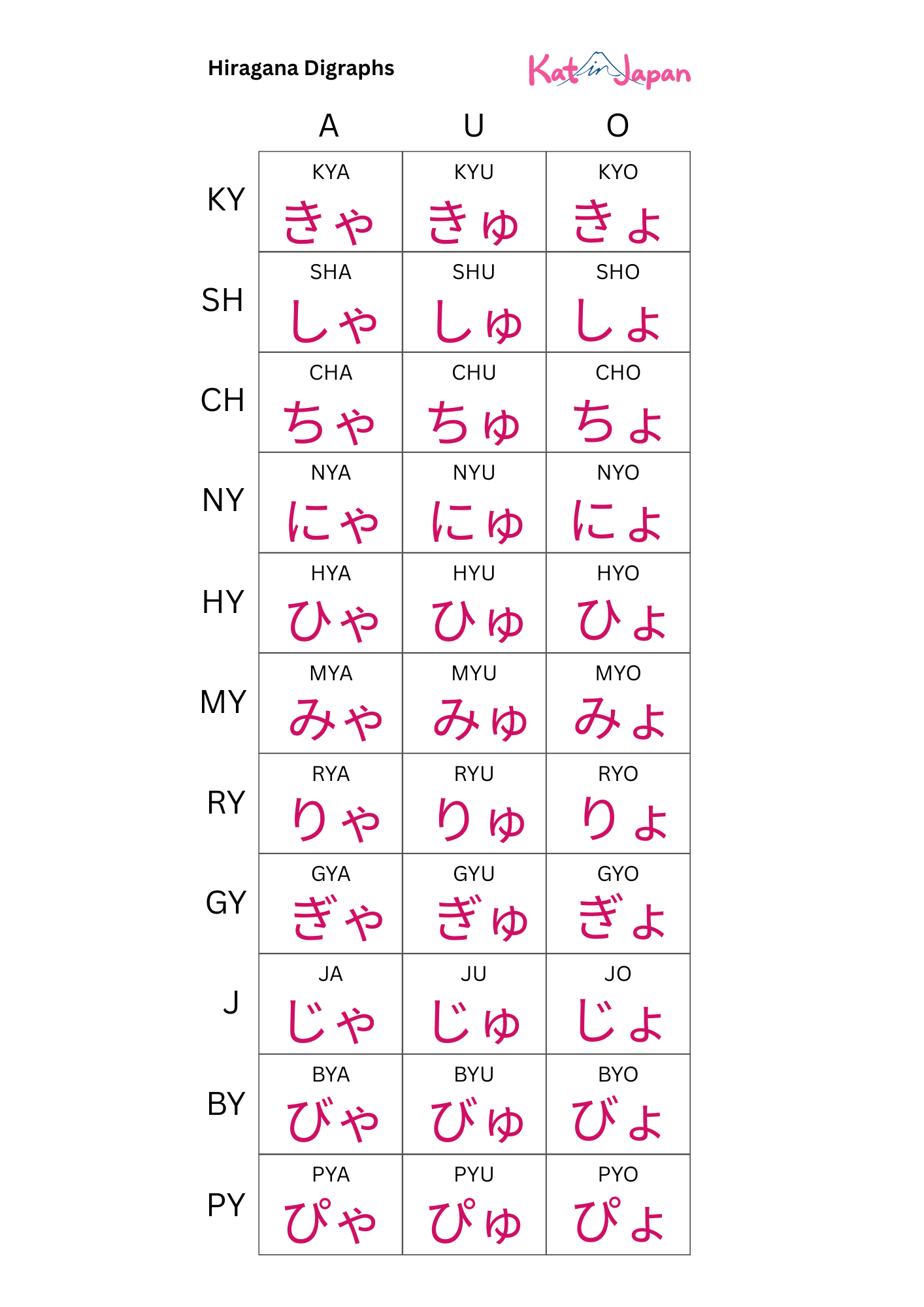
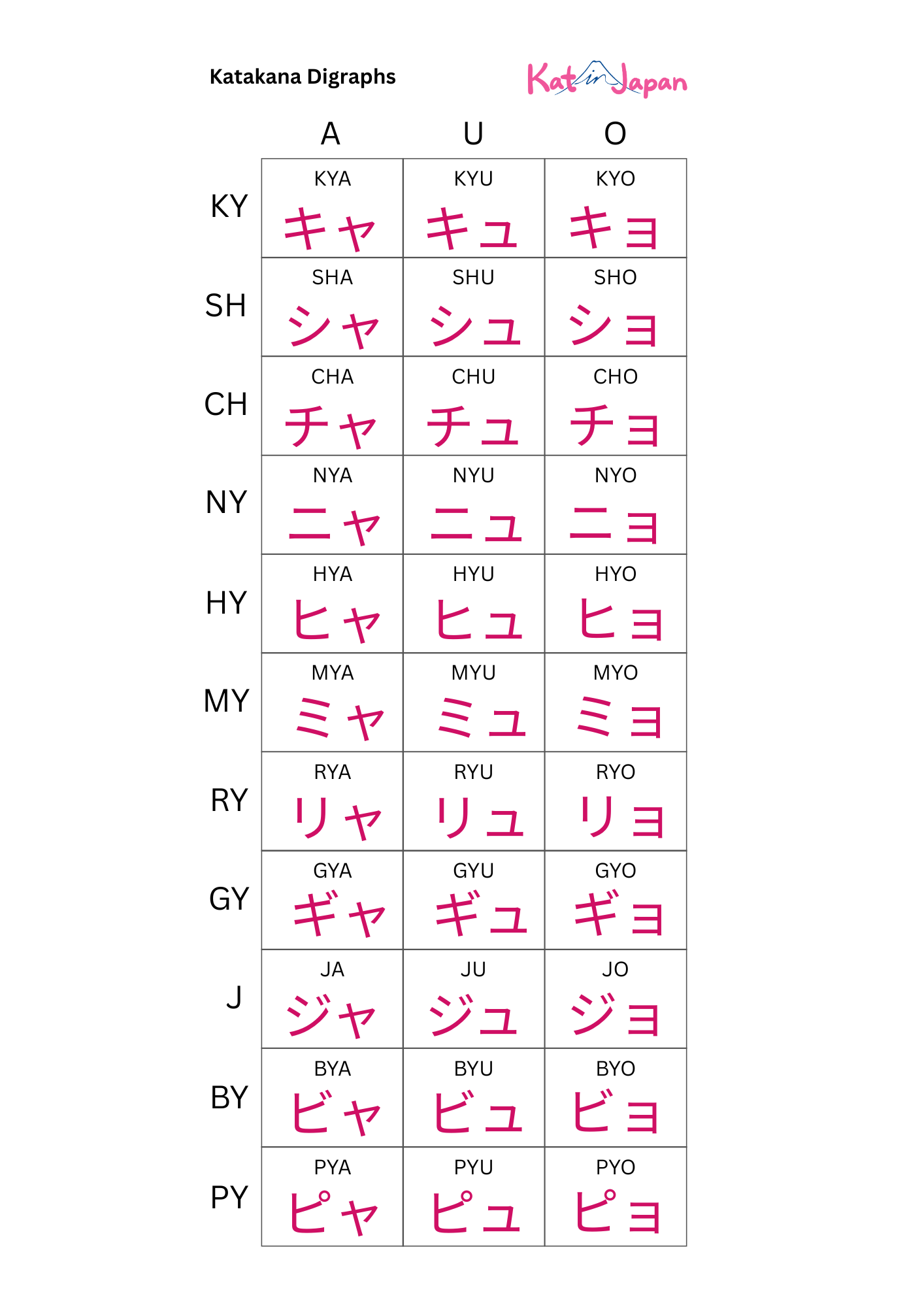
You can use the FREE downloadable worksheets to trace the digraphs, too. These are super important for everyday writing, so I highly recommend practicing them.
You’ll write the small letter to the bottom right of the main letter when writing from left to right. If you were writing top to bottom, the small letter would go underneath the main letter.
More Small Letters and Digraphs
By the way, ゃ ゅ and ょ aren’t the only small letters. We can also use small vowels: ぁぃぅぇぉ (ァィゥェォ) in some cases.
These are used primarily with katakana to help guide the pronunciation of foreign loan words.
For example:
シェフ (shefu) chef、チェリー (cherī) cherry、ジェヌイン (jenuin) genuine
Other foreign loan words may use these combinations of kana and small letters, too:
「イェ」ye 「ウィ」wi 「ファ」fa 「ティ」ti
Most commonly, you’ll see “ti” in words like パーティー (pātī) party. This is because the T line “I” sound is ち (chi), which sounds quite different from “ti” in English.
As you get more familiar with foreign loan words in katakana, these combinations will get easier to read, write, and understand. Don’t worry about learning everything at once. Language learning is a skill of mileage and interaction with the target language, after all.
By the way, you may see a small “ke” ヶ used on occasion. This is not used the same way as the other small letters. Instead, it takes the place of the kanji 「箇」as in 四ヶ月 (yonkagetsu) four months. Don’t worry about this usage yet.
Using the “Small” Tsu
Sometimes in Japanese, there may be an extra pause between sounds.
It’s represented by adding another small letter, and is often referred to as a glottal stop. While it can act that way, its most common use is to double the next consonant sound.
This special letter is a “small” tsu, otherwise known as a chīsai tsu or sokuon (促音). It is a very commonly used character, and signifies a pause or emphasizes a consonant. And it can be used with both hiragana (っ) and katakana (ッ).
For example:
buka (ぶか) subordinate vs. bukka (ぶっか) price
We doubled the sound of the “k” by adding the small tsu in between the “bu” and “ka”. Despite the slight difference, these are completely different words, so be careful.
Happy learning!